How Vogt-Plastic and NetterVibration are improving material handling, storage and logistics through efficient compaction
Recycling is a key element of a resource-efficient economy. But producing high-quality recycled plastics is only part of the challenge. The efficiency of the processes used to handle, store and transport recycled material also has a significant impact on both costs and sustainability.
A practical example comes from German plastics recycler Vogt-Plastic, which has improved the handling of processed plastic flakes by using vibration technology from NetterVibration.
From used packaging to recycled raw material
Vogt-Plastic is a technology-focused plastics recycling company with several sites in Germany. The company processes used plastic packaging collected through Germany's Yellow Bag recycling system and converts it into high-quality secondary raw materials for industrial applications.
The company produces recycled granulates from polyethylene (PE), polypropylene (PP) and polystyrene (PS). These regranulates are designed to match virgin plastic in processing performance while meeting demanding requirements for purity, particle size and homogeneity. The recycling process involves several stages, including sorting, washing, separation, shredding, processing, extrusion and homogenisation. After the contents of the Yellow Bags have been shredded, magnetic systems remove metallic components, while air separation is used to remove lightweight films. The material is then precisely sorted according to polymer type.
The resulting plastic flakes – known in the industry as regrind – are processed to particle sizes of up to approximately one centimetre. Before extrusion, the material is temporarily stored in Big Bags. It was precisely at this stage that Vogt-Plastic faced a recurring challenge.
The challenge: making better use of Big Bag capacity
When filled without additional compaction, the Big Bags were not distributed evenly. A conical void could form within the material, leaving the bags unstable and increasing the risk of tipping during internal transport by forklift truck.
There was also a risk of load shifting during road transport. At the same time, the uneven distribution of the material meant that the available volume of each Big Bag could not be used efficiently.
On average, the bags held only around 600 kg of plastic material. For a company handling large quantities of material around the clock, this had consequences extending beyond storage: transport and logistics costs were also affected.
Vibration technology creates a more compact load
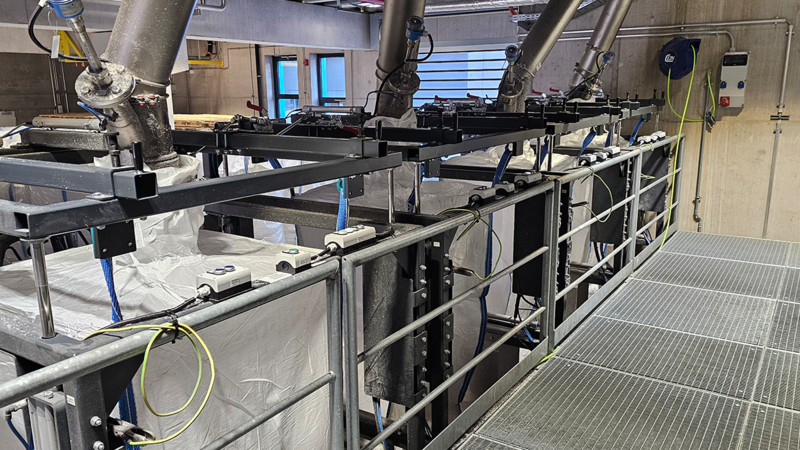
The solution was vibration. Vogt-Plastic now uses twelve VTF vibration tables from NetterVibration. The tables generate controlled vibrations that cause the material inside the Big Bags to settle and compact evenly.
This closes voids within the material and creates a more homogeneous and stable load. The result is a significantly better utilisation of the available Big Bag volume. Instead of approximately 600 kg, Vogt-Plastic can now fill each Big Bag with up to 800 kg of material. According to the case study, this represents a 33% saving in logistics costs. The improvement is particularly relevant in a continuous 24/7 operation, where even relatively small gains in capacity can have a substantial cumulative effect.
More than a question of logistics
Improving compaction is not simply about putting more material into each bag. A more uniform load also improves stability during handling and transport. For recycling operations, this can help reduce the risk of incidents caused by unstable loads while making material handling more predictable.
There is also a sustainability benefit. If more material can be transported in the same number of containers, fewer containers and transport movements may be required. This can reduce the associated energy consumption and CO₂ emissions.
VTF vibration tables for demanding bulk-material applications
NetterVibration supplied Vogt-Plastic with a solution tailored to its specific process requirements. Vibration technology can be used for containers and packages in a wide range of sizes – from smaller boxes and cartons through to large industrial containers.
Source: Based on “Effizienz beim Recycling steigern” by Jörg Dandl, originally published in Schüttgut 2 | 2026 by Vogel Communications Group.