Traditional methods such as bolting or welding have proven reliable for decades. However, welded brackets present a significant drawback: subsequent repositioning or modification together with the vibrator can become time-consuming and costly. Every welding process also affects surface quality, entails the risk of fine stress cracks and represents a hazard in ATEX zones. For this reason, OEMs increasingly consider the most suitable mounting elements – such as U-sections or steel plates – already during plant planning and design. For all other cases, adhesive consoles and vacuum mounts provide reliable and significantly more flexible alternatives.
1. Glueing as a Fastening Method: Gentle, Adaptable and Straightforward
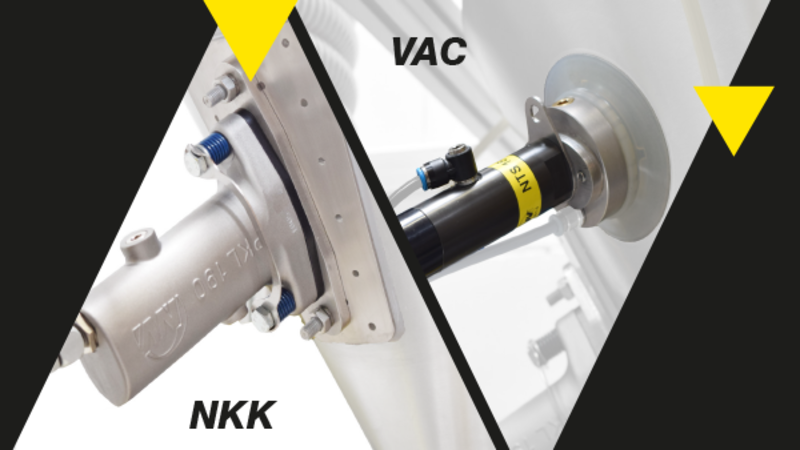
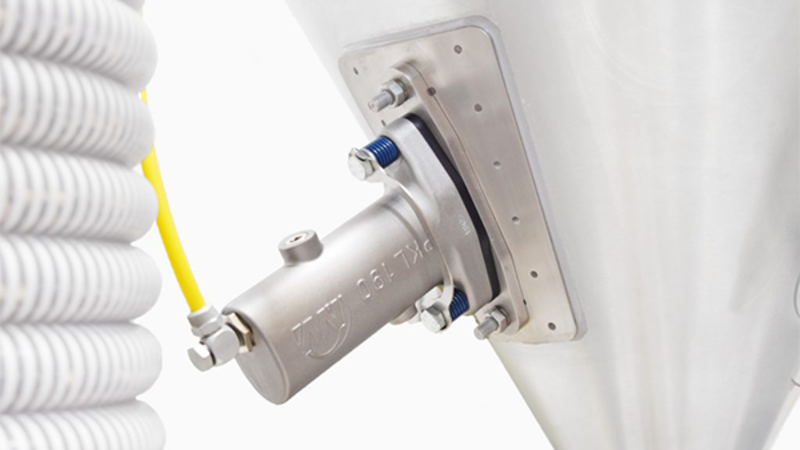
Mounting vibration equipment often becomes challenging – and quite frequently so – when requirements arise during operation, for example due to new bulk materials or modified formulations. Adhesive brackets for vibrators have established themselves as a flexible alternative to conventional mechanical fastenings. Adhesive mounting ensures even force distribution and therefore efficient energy transfer between the vibrator and the vessel. This prevents localised stress concentrations, which may occur with bolted connections. Bonding reduces the risk of material fatigue and cracking, which is particularly advantageous in dynamically stressed applications. Installation of the NKK is simple and fast: the bracket is attached using a flexible adhesive with minimal curing time and then serves as the carrier medium for the selected vibrators. During thorough cleaning procedures, unnecessary screws, crevices or profiles are avoided.
Advantages of Glueing at a Glance:
- Suitable for thin-walled or pre-damaged vessels, hoppers and pipes, as well as materials with limited weldability and certain plastics
- Approved for high-temperature applications up to 100 °C and for use in potentially explosive atmospheres (ATEX zones)
- Efficient energy transfer between vibrator and vessel
- Homogeneous force distribution: large bonding surfaces reduce stress peaks, increasing structural stability
- Installation possible during operation: minimises production downtime compared to welding or bolting
- Structural protection: no heat input means no metallurgical changes in bonded vessels, hoppers or silos
- Corrosion protection: bonding prevents moisture ingress at connection points, extending service life
- Weight reduction: elimination of welded plates and bolts enables lighter constructions
2. Vacuum Mounting: Flexible and Reusable Solution
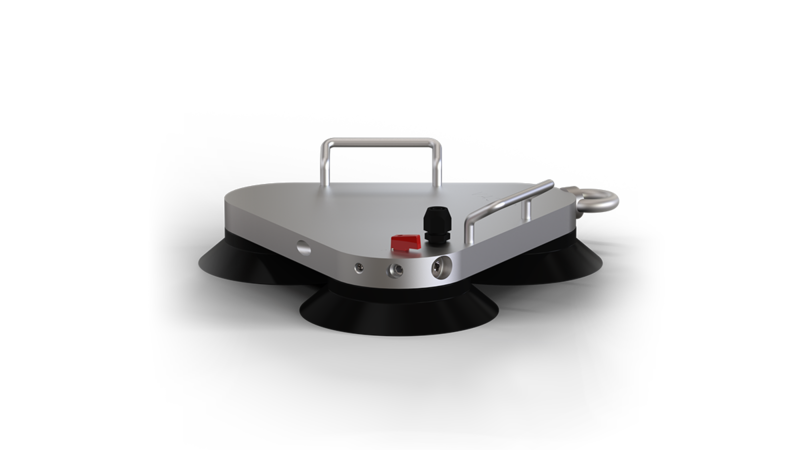
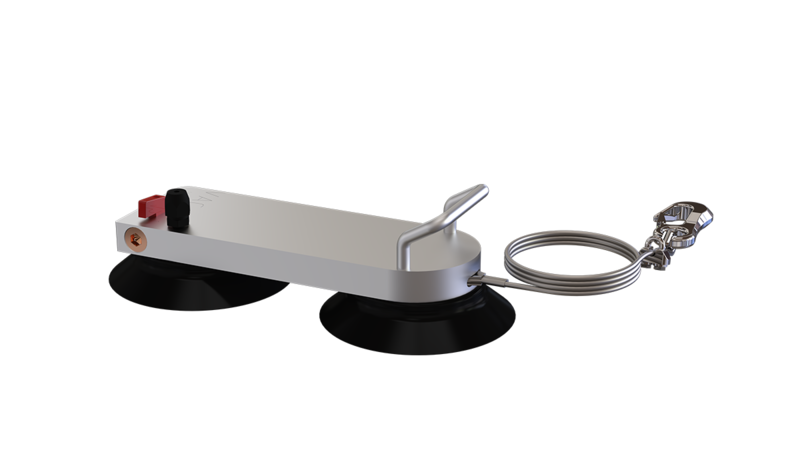
The VAC vacuum mounting system from Netter Vibration offers another innovative method of securing vibrators. A vacuum is generated to firmly fix the vibrator onto the surface of structures without affecting material or contents. This method is particularly advantageous when fast, residue-free dismantling is required or where conventional fastening methods are unsuitable due to surface characteristics. The VAC solution is also ideal for applications requiring frequent repositioning – for example when bulk material bridging occurs at varying discharge points of hoppers or silos, depending on fill level. Legal or operational regulations may require the use of VAC systems in ATEX zones, where welding and bolting are prohibited due to spark risks. The location-independent use of VAC systems also enables cost-efficient, non-permanent operation of vibrators in alternative production areas as required by process conditions.
A typical application is supporting the complete discharge of transport and interchangeable containers made of smooth metal or plastic. The VAC system is ideally combined with pneumatic or electric impactors of type PKL or ePKL. New to the Netter Vibration portfolio are fully electronic vacuum mounts that operate without compressed air and can even be battery-powered for use in remote locations or for maximum flexibility.
Advantages of Vacuum Mounting at a Glance:
- Fast installation and removal: vacuum control ensures a secure frictional connection between vibrator and surface – and easy release
- No mechanical damage: no drilling or bolting required; plant surfaces remain intact
- Reusability: vacuum mounts can be used repeatedly, supporting sustainable operation
- Tool-free handling enables rapid repositioning
- Safety chain meets occupational safety and accident prevention requirements
Read the full article here, Schüttgut, issue 1/2025 (German).